Che Wants to See You by Ciro Bustos
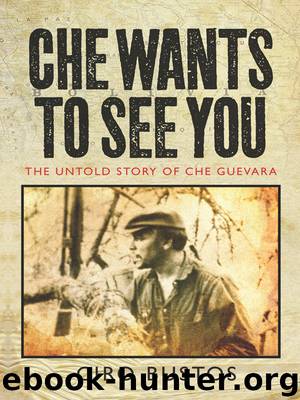
Author:Ciro Bustos
Language: eng
Format: epub, azw3
Publisher: Verso Books
Published: 2013-05-07T04:00:00+00:00
Part Four
Bolivia
24
‘Che Wants to See You’: January 1967
When I first lived in Salta, I shared a house with my friend Ramiro Dávalos in a town called Campo Quijano. The house was borrowed and we lived there in winter, but when the owners came for the summer, we moved to the hills where we set up camp in a couple of tents and held open house for Ramiro’s friends. They became my friends too: well-known poets, folk musicians or artists like him, and all enthusiastic drinkers of the unique Cafayate Torrontés wine, one of Argentina’s best (if not the best), grown in the Calchaquí Valley. I needed a place to paint too, so with the compensation I got from being laid off at the sugar mill, I rented a shed a couple of roads away.
Among the regular guests were two guitarists. One of them, Eduardo Falú, aka El Turco, from a Turkish family that settled in the north of Argentina, had perfect technique and was already challenging the reputation of Argentina’s folk legend, Atahualpa Yupanqui, on the airwaves. Eduardo was put in my tent, since Ramiro occupied the largest one with his wife Negrita and their children. Every day at around five in the morning, after a long night of singing and imbibing, I awoke to the sounds of paradise: gentle strumming, musical scales and miraculous chords. Guitar in his arms (like a woman, he said), Falú honed his technical skills and emitted the purest and most harmonious of sounds. The other maestro of the ‘viola’, as he called it, was of Spanish descent. He did not quite have Falú’s mastery of the instrument, but was nonetheless a fine musician and an inspired poet. His name was Ernesto Cabeza or Cabecita, and he became my closest friend. Cabecita fell on hard times at one stage and came to live in my Campo Quijano studio for a while, despite the cold.
Hence, in the silence of the night, or at dawn, I witnessed the birth of two of the most famous sambas in the Argentine folk repertory: Falú’s ‘La Candelaria’, composed in our tent, and Cabecita’s ‘La nochera’, created in my workshop. Romantic verses were added to both later by Jaime Dávalos, Ramiro’s brother, another friend and habitué. The miracles there were endless. Ramiro was the greatest cantor in the memory of the region, certainly the best I ever heard. A cantor by vocation of every folk tune in South America and especially of our precious northern Argentina, he rejected all professional or commercial offers, refused to sing in public and performed only for friends, despite being the envy of every bagualero and gaucho troubadour in the interior. There was only one amateur recording of his voice, made without Ramiro’s knowledge by our common friend, Alberto Burnichón, but it was such bad quality that it did not do him justice. His fame spread, however, and youngsters would come to listen to him in Campo Quijano, where he organized duets, trios or quartets with
Download
This site does not store any files on its server. We only index and link to content provided by other sites. Please contact the content providers to delete copyright contents if any and email us, we'll remove relevant links or contents immediately.
Fanny Burney by Claire Harman(26662)
Empire of the Sikhs by Patwant Singh(23136)
Out of India by Michael Foss(16987)
Leonardo da Vinci by Walter Isaacson(13412)
Small Great Things by Jodi Picoult(7230)
The Six Wives Of Henry VIII (WOMEN IN HISTORY) by Fraser Antonia(5559)
The Wind in My Hair by Masih Alinejad(5140)
A Higher Loyalty: Truth, Lies, and Leadership by James Comey(5018)
The Crown by Robert Lacey(4865)
The Lonely City by Olivia Laing(4843)
Millionaire: The Philanderer, Gambler, and Duelist Who Invented Modern Finance by Janet Gleeson(4539)
The Iron Duke by The Iron Duke(4407)
Papillon (English) by Henri Charrière(4324)
Sticky Fingers by Joe Hagan(4256)
Joan of Arc by Mary Gordon(4157)
Alive: The Story of the Andes Survivors by Piers Paul Read(4078)
Stalin by Stephen Kotkin(4007)
Aleister Crowley: The Biography by Tobias Churton(3672)
Ants Among Elephants by Sujatha Gidla(3495)
